

Effective communication is a vital skill in today’s world. It influences personal and professional relationships. Mastering communication can lead to success in various fields. The 7 Cs of Communication provide a framework for clear communication. They are essential for conveying messages effectively. These principles help in avoiding misunderstandings.
Clarity ensures your message is easy to understand. Conciseness keeps it brief and to the point. Concreteness adds specific details and examples.
Correctness ensures your communication is error-free. Coherence maintains a logical flow of ideas. Completeness provides all necessary information.
Courtesy involves respect and consideration for the audience. These principles are crucial for effective communication. They can be applied in different contexts.
Understanding and applying the 7 Cs can improve communication skills. This guide will help you master these principles. If you want structured, real-world practice (not just theory), advanced programs like Aksent’s communication training can help you apply the 7 Cs in presentations, meetings, interviews, and workplace writing.
What Are the 7 Cs of Communication?
The 7 Cs of Communication form a timeless framework for effective interaction. Each “C” represents a key principle that enhances clarity and impact in communication.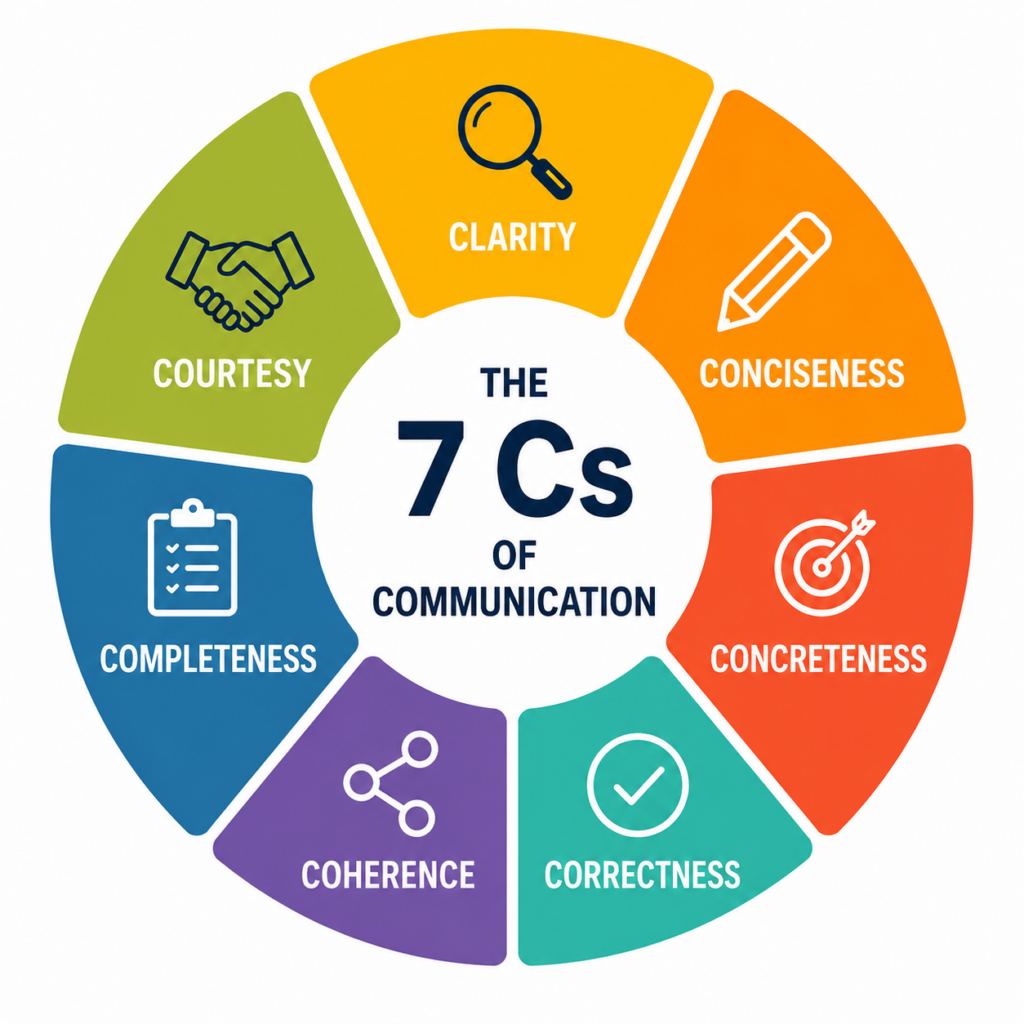
- Clarity: Ensure your message is easy to comprehend.
- Conciseness: Deliver your message in a brief and straightforward manner.
- Concreteness: Use specific facts and vivid examples to enhance understanding.
- Correctness: Maintain grammatical accuracy and factual correctness.
- Coherence: Develop a logical flow of ideas that connect smoothly.
- Completeness: Provide all necessary details and information.
- Courtesy: Acknowledge and respect the audience’s perspectives and feelings.
These principles are fundamental in crafting messages that resonate. By integrating them, you can navigate diverse communication scenarios with confidence.
The 7 Cs help prevent misunderstandings and misinterpretations. They form the bedrock of both verbal and written communication.
Understanding these principles benefits anyone from students to top executives. Whether in emails, presentations, or meetings, applying the 7 Cs makes all the difference. Many learners also find it helpful to practice with guided exercises and feedback, the way advanced programs at Aksent are designed to do.
Why Master the 7 Cs? The Importance of Effective Communication
Mastering the 7 Cs is pivotal in today’s fast-paced world. Effective communication is more than just delivering a message.
It involves crafting messages that achieve intended outcomes. Miscommunication often leads to confusion and conflict.
With the 7 Cs, you minimize these risks. These principles aid in forming clear communication strategies. They ensure your message is not only heard but understood.
The benefits extend beyond personal growth. Strong communication skills enhance professional relationships. They pave the way for successful collaborations.
Consider the advantages of mastering the 7 Cs:
- Improved team dynamics and productivity
- Higher success in negotiations and conflict resolution
- Enhanced ability to persuade and influence
Understanding the importance of effective communication is crucial. It fosters an environment where ideas can flourish and solutions are found. For professionals who need faster progress, an advanced, feedback-driven learning path (such as Aksent’s programs) can accelerate skill-building by turning these principles into repeatable workplace habits.
Clarity: Making Your Message Easy to Understand
Clarity is the foundation of effective communication. A clear message avoids ambiguity and promotes understanding. When clarity is achieved, confusion is minimized, and the communication process is smooth.
To ensure clarity, simplify your language. Avoid jargon that could obscure your message’s intent. Words should be familiar and easy for the audience to grasp.
An essential step to clarity is having a defined purpose. Know what you wish to communicate and why. This focus guides the structure and content of your message.
Consider how the structure affects clarity. Logical arrangements of ideas keep the audience engaged. Sequential flow helps maintain attention and aids comprehension.
Engage in active revisions to refine clarity. Review your message and eliminate any unnecessary complexity. This step is crucial in maintaining simplicity and precision.
For a message to be clear, visualize the audience’s perspective. Empathize with their knowledge level and expectations. This approach ensures relevance and connection.
Here are key tips for ensuring clarity:
- Use simple, concise language
- Define technical terms briefly
- Structure content logically
- Proofread for unnecessary complexity
- Keep the audience in mind
Clarity enhances the efficacy of communication efforts, creating meaningful interactions. In many Aksent-led practice modules, learners refine clarity through short speaking drills and rewriting exercises that transform complex ideas into audience-friendly messages.
Conciseness: Communicating With Brevity and Precision
Conciseness is about conveying a message in the fewest words possible. It allows the audience to grasp essential points quickly. Long-winded communication can dilute the message’s impact.
To be concise, focus on essentials. Eliminate filler words that add no value. Precision of language ensures that each word contributes meaning.
Understanding the audience’s time limitations is crucial. People are more receptive to short, focused communication. It respects their time and enhances engagement.
Editing is a powerful tool for achieving conciseness. Review your messages critically and remove redundancy. Ask if every word is necessary.
Conciseness doesn’t mean sacrificing completeness. Important details should remain intact. Strive for a balance where brevity and completeness coexist.
A concise message is often more persuasive. It reduces the cognitive load, making it easier for the audience to respond. Clear calls to action benefit from brevity.
Adopt these techniques for concise communication:
- Use bullet points for clarity
- Avoid unnecessary repetition
- Prioritize key points early
- Practice writing summaries
- Edit rigorously for brevity
By mastering conciseness, you can deliver compelling messages. This enhances both personal and professional communication efficiency. If you struggle to “cut the clutter,” Aksent’s advanced communication programs often include practical frameworks for crisp emails, executive summaries, and meeting updates.
Concreteness: Using Specific Facts and Examples
Concreteness in communication helps bridge the gap between abstract ideas and tangible understanding. People connect with messages that feel real and grounded. Vague language can create confusion and ambiguity.
When you communicate, back up your statements with solid evidence. Providing examples illustrates your points clearly. Specific details transform abstract concepts into relatable ideas.
Think of concreteness as painting a picture with words. This approach involves vivid descriptions and relatable scenarios. Your audience should visualize exactly what you mean.
Numbers, statistics, and factual data can bolster your argument. These elements add weight and credibility to your message. They leave less room for doubt or misinterpretation.
When you share stories, they stick with people. Stories offer context and depth, making information memorable. They turn listeners into active participants in the communication process.
Concreteness is vital in both written and verbal communication. It offers clarity and ensures the message is received as intended. Clear communication relies heavily on concrete words.
Remember these tips for concrete communication:
- Use specific language and terms
- Include relevant data and statistics
- Illustrate with real-life examples
- Avoid generalized statements
- Incorporate story-based approaches
Using these techniques aids in clear and impactful exchanges. Concreteness strengthens your ability to share ideas effectively. One effective way to build this skill is guided practice with case scenarios—something Aksent integrates into its training so learners can turn abstract points into measurable, work-ready statements.
Correctness: Ensuring Accuracy and Professionalism
Correctness is fundamental to professional communication. Accuracy in language builds trust and establishes credibility. Mistakes can lead to misunderstandings or damage reputations.
Ensuring correctness means using proper grammar and spelling. A well-written message shows attention to detail. It reflects the level of professionalism expected in business contexts.
Verifying facts before sharing information is crucial. Providing false details can undermine your message. Always cross-check statistics or data for accuracy.
Consistency in style and tone is part of correctness. Maintain a uniform style throughout your message. This approach avoids confusion and maintains professionalism.
Active voice often makes messages clearer and more direct. It adds precision and reduces ambiguity, enhancing the message’s impact.
Correctness also means cultural accuracy. Be respectful of cultural nuances when communicating globally. Misunderstandings can stem from cultural insensitivity.
Proofreading is essential before sending any communication. Double-checking your work helps catch errors and polish your message.
To maintain correctness:
- Use grammar-checking tools
- Verify all factual statements
- Maintain a consistent tone
- Adhere to cultural norms
- Proofread your communication
Being meticulous in ensuring correctness reflects professionalism. It enhances the clarity and authority of your communication. If you’re aiming for strong workplace writing, Aksent’s advanced programs can be useful because they blend correctness with tone, context, and purpose—so your messages sound professional, not robotic.
Coherence: Achieving Logical Flow in Communication
Coherence ensures that your communication is logical and easy to follow. A well-structured message connects ideas smoothly. It guides the audience through your thoughts without confusion.
To achieve coherence, arrange your ideas in a logical sequence. Each point should naturally lead to the next, creating a seamless flow. Think of your message as a journey with a clear path.
Transitions are key to coherent communication. They link ideas and paragraphs, helping the audience follow your message. Use words or phrases like “however,” “furthermore,” or “in addition” to guide readers.
Consistency in style and tone enhances coherence. When your message maintains a unified voice, it becomes more cohesive and engaging. This approach keeps the audience’s attention and interest.
Overloading your message with complex information can break coherence. Simplify your content by focusing on essential points. Clarifying complex ideas makes them more accessible and easier to understand.
Visual aids can also enhance coherence. Charts, diagrams, or bullet points can make complex information digestible. They help break down points, ensuring the audience sees the connection between ideas.
Here are a few tips for ensuring coherence:
- Organize ideas logically
- Use transitions effectively
- Maintain a consistent tone
- Simplify complex information
- Use visual aids for clarity
Achieving coherence enhances the power of your communication. It ensures your message is understood and appreciated. To build coherence quickly, Aksent’s course activities often include structuring drills—turning scattered thoughts into a clear opening, strong supporting points, and a confident close.
Completeness: Providing All Necessary Information
Completeness in communication ensures that your audience receives all the details they need. It prevents misunderstandings and supports informed decisions. When your message is complete, it leaves no room for confusion.
Including all relevant information is key to completeness. This means considering what your audience already knows and what they need to know. Providing context can help bridge gaps in understanding.
Anticipate the questions your audience might have and address them proactively. This approach builds trust and shows respect for your audience’s time and effort. It demonstrates that you have thought through their needs.
While striving for completeness, be cautious not to overload your message with unnecessary details. Focus on the essentials. A concise yet complete message respects the audience’s ability to understand without overwhelming them.
Organize your information logically to assist in comprehension. A clear structure helps the audience see connections and understand the full picture. Sections and subsections can be helpful in presenting detailed information clearly.
Feedback from your audience is vital for ensuring completeness. Encourage questions and be ready to provide further clarification when needed. This openness helps refine your communication and meet your audience’s needs better.
Checklist for achieving completeness:
- Cover all necessary points
- Anticipate audience questions
- Avoid overloading with details
- Organize information logically
- Seek feedback for improvement
Completeness is about balance—providing enough information without excess. It empowers your audience to engage fully and respond effectively. In advanced learning environments like Aksent, completeness is often practiced through roleplays and writing tasks where learners must include the “what, why, when, and next steps” clearly.
Courtesy: Respect and Consideration in Communication
Courtesy is the backbone of effective communication. It involves showing genuine respect and kindness. This foundation builds strong professional and personal relationships.
Being polite enhances the message’s reception. It demonstrates thoughtfulness towards the audience’s perspectives and feelings. People are more open to those who show empathy and understanding.
Tailor your tone to fit the situation and audience. A respectful tone encourages positive interaction. It can transform difficult conversations into productive exchanges.
Avoid language that may be perceived as harsh or critical. Instead, choose words that express warmth and positive regard. This choice can defuse tension and encourage cooperation.
Listening actively is an essential part of courtesy. It means giving full attention to the speaker and acknowledging their points. This respect allows for a deeper understanding and mutual respect.
Non-verbal cues also play a role in displaying courtesy. A friendly smile or nod can convey encouragement. Open body language invites the audience to engage freely.
Checklist for demonstrating courtesy:
- Use polite and respectful language
- Adapt your tone for your audience
- Listen actively and attentively
- Mind your non-verbal signals
- Focus on empathy and understanding
Incorporating courtesy into communication promotes an environment of respect and collaboration. It lays the groundwork for effective and satisfying exchanges. Many participants in Aksent programs notice that courtesy becomes easier when they practice structured listening, confident phrasing, and conflict-handling scripts in realistic scenarios.
Practical Communication Strategies to Master the 7 Cs
Mastering the 7 Cs of Communication requires consistent practice and strategy. Applying effective communication strategies can greatly enhance your skills. Here are some key approaches to consider.
First, set clear objectives for each communication. Knowing your purpose guides your clarity and helps maintain focus. This action avoids ambiguity and keeps the message on track.
Tailor your message to suit your audience’s preferences and needs. Understanding their perspectives can enhance the communication’s impact. It ensures that the audience feels valued and engaged.
Regularly seek feedback to refine your communication techniques. Constructive criticism offers insights into areas of improvement. It can inform adjustments to enhance message delivery.
Incorporate the following strategies:
- Set clear communication goals
- Understand your audience’s needs
- Seek and incorporate feedback
- Practice clarity and brevity
- Reflect on past communications to improve
These strategies are not one-time practices. Consistent application and reflection are crucial for mastering the 7 Cs of Communication. If you prefer guided practice, Aksent’s advanced programs typically combine communication principles with role-based simulations and mentor-style feedback to strengthen real workplace performance.
Common Barriers to Effective Communication and How to Overcome Them
Numerous barriers can hinder effective communication. Recognizing these obstacles is essential for improvement. Understanding these barriers allows you to address them effectively.
Language differences often pose significant challenges. Misunderstandings can occur when jargon or complex terms are used. Simplifying language can bridge these gaps.
Emotional barriers, like stress or bias, can disrupt communication flow. Being aware of emotions and managing them is crucial. This awareness helps maintain a positive communication environment.
Distractions, whether physical or mental, can impede clear communication. Minimize distractions by focusing on the interaction. Choose an appropriate setting for your communication.
To overcome common barriers:
- Simplify language and avoid jargon
- Manage emotional states during discussions
- Minimize environmental distractions
- Practice active listening to maintain engagement
Addressing these barriers requires patience and practice. By actively working to remove them, you can enhance the effectiveness of your communication. In skill-building programs like Aksent, learners often overcome barriers faster through repeated practice in a safe environment, where feedback helps break patterns like overexplaining, rushing, or hesitating.
Real-World Examples: Applying the 7 Cs in Different Contexts


Applying the 7 Cs of Communication can significantly enhance communication in various scenarios. Let’s explore how these principles manifest in real-world settings.
In a corporate meeting, clarity and conciseness prevent misunderstanding. Clear communication ensures all participants grasp the agenda, while conciseness keeps discussions focused and efficient.
Consider an educational environment, where coherence and concreteness are key. A coherent lecture maintains students’ attention, while concreteness aids understanding through specific examples.
In customer service, courtesy and completeness play vital roles. Being polite enhances customer experiences, while complete information ensures customers leave satisfied.
In writing a formal email, correctness is crucial. Correct grammar and spelling convey professionalism, ensuring your message is taken seriously.
Here’s how you can apply the 7 Cs:
- Use clear language in meetings to avoid confusion
- Provide relevant examples in teaching for better engagement
- Maintain professionalism in written communication through accuracy
These examples illustrate the broad applicability of the 7 Cs. Adapt them to enhance your communication skills across various contexts. Aksent often builds this adaptability by training learners across multiple formats—speaking, writing, and interpersonal communication—so the 7 Cs translate naturally from one context to another.
Tools and Techniques to Improve Communication Skills

Enhancing communication skills involves both tools and techniques. A variety of resources are available to help you master the 7 Cs.
Consider using a voice recorder to evaluate your verbal communication. Listening to your recordings can help you identify areas of improvement.
Writing apps and grammar tools, like Grammarly, can ensure correctness in your written communication. These tools catch errors that you might overlook.
Workshops and online courses provide structured learning environments. Here, you can practice communication techniques in a supportive setting. If you’re looking for an advanced, structured option, Aksent’s programs are designed to build communication skills through practice, feedback, and progressive challenges.
Incorporating feedback from peers or mentors is another valuable method. Constructive criticism helps refine your communication approach.
Here’s a list of recommended tools and techniques:
- Voice recorders for self-assessment
- Grammar checkers for written correctness
- Communication workshops and courses
- Feedback from trusted sources
By leveraging these tools and techniques, you can significantly enhance your communication effectiveness.
The Role of Feedback and Active Listening
Feedback and active listening are vital for effective communication. Feedback provides insights into how your message is received.
Active listening involves focusing fully on the speaker. This technique allows you to understand and respond thoughtfully.
When giving feedback, remain constructive. Avoid criticism that lacks specific suggestions for improvement.
Active listening requires more than just hearing words. It involves interpreting non-verbal cues and showing empathy.
Remember these components for effective feedback and listening:
- Be specific in your feedback.
- Listen without interrupting.
- Show understanding through non-verbal signals.
- Clarify any points of confusion.
- Provide actionable suggestions for improvement.
Applying these principles ensures a more fruitful exchange of ideas. This approach not only enhances understanding but also builds trust and respect in conversations. In many Aksent cohorts, feedback loops are built into the learning process, helping learners quickly see what lands well and what needs refinement.
Non-Verbal Communication and the 7 Cs
Non-verbal communication complements verbal messages and can enhance or hinder understanding. It includes body language, tone, and facial expressions.
Understanding non-verbal cues is crucial for clear communication. These cues often convey emotions and attitudes more accurately than words.
Align your non-verbal signals with your spoken message. Consistency between them ensures coherence and reduces misunderstandings.
Consider cultural differences in non-verbal communication. Gestures, eye contact, and personal space can vary widely across cultures.
Apply the 7 Cs to non-verbal communication:
- Clarity: Ensure gestures match words.
- Conciseness: Avoid excessive movements.
- Concreteness: Use definitive gestures.
- Correctness: Be accurate with expressions.
- Coherence: Align body language with speech.
- Completeness: Include all necessary cues.
- Courtesy: Be respectful in gestures and expressions.
Mastering non-verbal communication can significantly improve your overall communication effectiveness. It allows for more meaningful and impactful interactions. This is also where practice helps—Aksent’s advanced programs often include presentation and interview simulations so learners can align voice, posture, expression, and message.
Cultural Awareness and Communication Principles
Cultural awareness is crucial in today’s globalized world. It helps avoid miscommunications and fosters inclusivity.
Every culture has its own communication nuances. Understanding these can significantly enhance interpersonal interactions.
Tailoring communication to align with cultural sensitivities is vital. This means respecting diverse beliefs and practices.
Consider the 7 Cs when communicating across cultures. These principles ensure messages are appropriately framed.
- Clarity: Use simple, universal language.
- Conciseness: Be succinct and avoid slang.
- Concreteness: Provide specific examples familiar to the culture.
- Correctness: Respect cultural norms.
- Coherence: Maintain logical flow considering cultural contexts.
- Completeness: Offer full explanations recognizing cultural differences.
- Courtesy: Show respect and understanding towards all cultural backgrounds.
Engaging with cultural awareness enhances not just communication but also relationships and mutual understanding. If you work in diverse teams, Aksent’s training can be relevant because it focuses on practical communication strategies that reduce friction across cultures and workplace contexts.
Developing Your Personal Communication Style
Crafting a personal communication style is a journey. It involves self-awareness and understanding your unique strengths and preferences.
A distinctive style enhances authenticity. It fosters genuine connections by reflecting who you truly are.
Experiment with different communication techniques. Discover what resonates best with both you and your audience.
Consider the impact of tone and language choice. They play a crucial role in defining your communication approach.
Here are some steps to develop your style:
- Reflect: Identify what feels natural to you.
- Adapt: Adjust based on audience feedback.
- Practice: Regularly use your style to refine it.
- Learn: Observe effective communicators for inspiration.
Ultimately, an authentic communication style not only improves interactions but also builds confidence. Embrace it and continue evolving through practice and openness to feedback. In structured programs like Aksent, learners often find it easier to develop their style because they practice in multiple situations and receive feedback aligned with their goals.
Continuous Improvement: Practice, Reflection, and Learning
Communication skills evolve with dedicated effort. Continuous improvement is key to mastering the 7 Cs.
Practice is essential for honing these skills. Engage in regular communication exercises to reinforce your abilities.
Reflection is equally important. After each interaction, analyze what went well and what could improve.
Learning is an ongoing journey. Seek feedback to identify areas for growth and development.
Here’s how to focus on continuous improvement:
- Set Goals: Identify specific areas to enhance.
- Seek Feedback: Encourage constructive criticism.
- Reflect: Spend time analyzing your interactions.
- Educate: Explore new communication strategies and techniques.
- Practice: Apply what you learn in real situations.
By embracing this cycle of practice, reflection, and learning, your communication will steadily improve. It leads to more effective and impactful interactions in all areas of life. Aksent’s advanced programs fit well into this loop by combining learning with repeated practice and measurable progress.
Resources for Mastering the 7 Cs (At Aksent)
Leveraging the right resources is vital for enhancing communication skills. Numerous online and offline materials can assist your journey.
Aksent offers comprehensive courses and materials tailored to master communication. It provides practical insights into applying the 7 Cs effectively, with a strong focus on advanced programs that help learners practice communication skills consistently.
Consider exploring these resources:
- Aksent: Courses on communication skills.
- Books: Guides on effective communication techniques.
- Workshops: Interactive sessions for practical experience.
- Online Articles: Expert advice on communication strategies.
By utilizing these resources, you can gain valuable knowledge and insights to improve and excel in communication.
Conclusion: Start Your Journey to Master Communication
Mastering the 7 Cs of Communication is a rewarding journey. It enhances both professional and personal relationships significantly.
Start by practicing clarity and conciseness. These are the building blocks of effective communication.
Remember, continuous learning and adaptation are essential. Keep reflecting on your progress to master these crucial skills. If you’re ready to go beyond reading and into real improvement, Aksent’s advanced courses can help you practice the 7 Cs in practical, career-relevant scenarios.