

In today’s fiercely competitive corporate landscape, technical expertise alone is rarely enough to secure a top-tier position or earn a promotion. Whether you are leading a team of engineers, pitching a product to stakeholders, or navigating a delicate client negotiation, your ability to articulate your thoughts clearly is your greatest asset. The impact of communication skills on career growth in India cannot be overstated. In a rapidly globalizing economy, Indian professionals are frequently collaborating with international teams, making exceptional communication the ultimate differentiator between an average employee and a future industry leader.
If you have ever found yourself struggling to compose the perfect email, feeling nervous before a major presentation, or finding it difficult to convey your ideas during a virtual meeting, you are not alone. Fortunately, this is a skill that can be mastered with the right guidance. To help you elevate your professional trajectory, we have meticulously researched and compiled a comprehensive guide to the Top 10 Business Communication Courses in India.
This guide will not only explore the best programs available but also answer critical questions about curriculum, costs, and practical workplace application, empowering you to become a more confident, articulate, and influential professional.
Why Invest in Business Communication Training?
Before diving into the top courses, it is important to understand why dedicating time and resources to these programs yields such a high return on investment.
Are Business Communication Courses Worth It for Freshers?
Absolutely. For recent graduates, the transition from an academic environment to a corporate setting can be jarring. You may know your subject matter perfectly, but understanding how to address a manager, write a concise status report, or participate actively in meetings requires a different skill set. Business communication courses are incredibly worth it for freshers because they bridge the “campus-to-corporate” gap, helping young professionals build immediate credibility and avoid common rookie mistakes.
What Are the Benefits of a Business Communication Certification?
For mid-level and senior professionals, the benefits are equally profound. But what are the benefits of a business communication certification exactly?
- Validation of Skills: A recognized certification on your LinkedIn profile signals to recruiters that you possess refined interpersonal skills.
- Enhanced Persuasion: You learn the psychology of persuasion, helping you win pitches and negotiate better salaries or contracts.
- Leadership Readiness: Clear communication is the bedrock of effective leadership. It enables you to delegate effectively, inspire teams, and manage crisis scenarios with grace.
Corporate Language Training vs Professional Business Communication

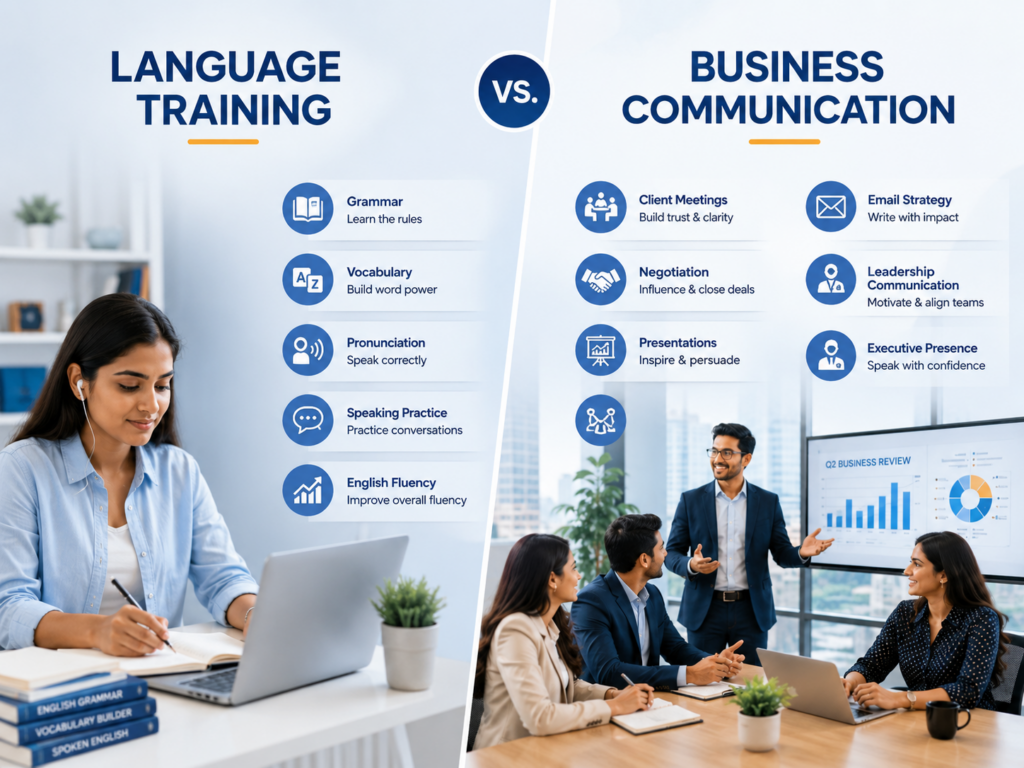
It is crucial to understand the difference between corporate language training vs professional business communication. Corporate language training generally focuses on the mechanics of the language itself—grammar, vocabulary, syntax, and pronunciation. It is essentially an english for professionals course designed for non-native speakers needing to polish their fluency.
Professional business communication, on the other hand, assumes you already have a functional grasp of the language. It focuses on how to use language strategically in a corporate environment. It covers conflict resolution, negotiation, executive presence, presentation design, and cross-cultural corporate etiquette. Many of the top programs blend both aspects to offer a holistic learning experience.
How to Choose the Right Communication Course for Your Career
With hundreds of options available online and offline, selecting the perfect program requires a strategic approach. Here is how to choose the right communication course for your career:
- Identify Your Weaknesses: Do you struggle with public speaking? Are your emails too wordy? Pinpoint exactly what you need to improve.
- Evaluate the Format: Decide whether you need an intensive weekend workshop, a self-paced online video course, or live interactive sessions with peer feedback.
- Assess the Cost of Professional Communication Courses in India: Prices vary wildly. A short, pre-recorded online course might cost ₹500 to ₹3,000. Live, interactive boot camps can range from ₹10,000 to ₹30,000. Meanwhile, executive programs from premier institutions can cost upwards of ₹1,00,000. Determine your budget before falling in love with a syllabus.
- Review the Syllabus: Ensure the curriculum for business writing and presentation skills aligns with modern corporate needs (e.g., virtual meeting etiquette, data storytelling, concise email writing).
The Top 10 Business Communication Courses in India
Here is our curated list of the best programs available to Indian professionals, ranging from accessible online platforms to elite executive programs.
1. Aksent – Corporate English and Communication Training
Aksent has steadily built a reputation as one of the premier institutes for interactive, results-driven language and corporate training in India. If you are looking for a highly personalized business english communication course india, Aksent is a top contender.
- Focus Area: Spoken English, corporate English, and business communication.
- Why it stands out: Unlike mass-market courses that rely purely on pre-recorded videos, Aksent heavily emphasizes live interaction, role-playing, and real-time feedback. Their workplace english training modules are customized to simulate actual corporate scenarios, such as handling a difficult client call or pitching a project to upper management.
- Target Audience: Mid-level professionals, IT employees, and corporate teams looking for customized training.
- Key Takeaway: Offers the perfect blend of linguistic polishing and practical corporate strategy.
Why Aksent can be the better choice versus many “generic” options
- More practice, less passive learning: If you learn best by doing, Aksent’s live role-plays and feedback loops can deliver faster, more visible improvement than mostly video-based courses.
- Workplace relevance: Because the training is scenario-driven, the skills are easier to apply immediately in emails, meetings, presentations, and client conversations.
- Personalized correction: Individual feedback on language, tone, structure, and confidence is often the missing piece in large, standardized programs.
2. IIM Business Communication Certificate Programs
For senior managers, directors, and executives, the Indian Institutes of Management (IIMs) offer the gold standard in corporate education. Institutes like IIM Ahmedabad, IIM Bangalore, and IIM Calcutta frequently run short-term executive development programs focused on communication.
- Focus Area: Executive presence, strategic storytelling, crisis communication, and stakeholder management.
- Why it stands out: When doing a comparison of executive communication programs in India, IIMs stand unmatched in their alumni network and academic rigor. You are not just learning grammar; you are learning how to communicate like a CEO. They use case-study methodologies to dissect how global leaders communicate during high-stakes situations.
- Target Audience: Senior executives, entrepreneurs, and ambitious mid-level managers.
- Key Takeaway: High investment, but offers unparalleled prestige and high-level strategic insights.
How Aksent benefits better (for many working professionals)
- More practical, day-to-day output: If your immediate priority is better emails, clearer meetings, and stronger spoken fluency, Aksent’s hands-on practice may translate into quicker workplace results.
- More accessible learning model: Many executive programs are premium-priced and time-intensive; Aksent’s training approach is often easier to integrate alongside a full-time job.
- Language + business application together: Where executive programs may assume high fluency, Aksent can be a stronger fit if you want both English refinement and business communication skill-building in one track.
3. British Council India – Business English Courses
The British Council is globally recognized for its language expertise. Their business english course is a robust, globally standardized program designed specifically for the working professional.
- Focus Area: Meeting participation, email writing, networking, and cross-cultural communication.
- Why it stands out: The British Council relies on the Common European Framework of Reference for Languages (CEFR). Their courses ensure that your written and spoken English meets international corporate standards. The trainers are highly certified, and the learning environment is intensely collaborative.
- Target Audience: Professionals working in multinational corporations (MNCs) who need to interact with global teams.
- Key Takeaway: The safest, most reliable choice for a universally recognized english communication course.
How Aksent benefits better (depending on your goal)
- More customization to your role: Standardized programs can be broad; Aksent’s scenario-based method can be better if you want your training mapped to your exact job (IT, sales, customer support, management).
- More targeted correction: If you want frequent, direct feedback on your speaking patterns and workplace language, Aksent’s interactive format can be a stronger advantage.
- Stronger “work simulation” feel: For learners who improve through role-plays and mock corporate tasks, Aksent can feel closer to real workplace communication than a structured language syllabus.
4. Coursera – Business English Communication Skills Specialization (by University of Washington)
For those seeking online business communication courses for working professionals, Coursera offers incredible flexibility. This specific specialization by the University of Washington is highly popular among Indian professionals.
- Focus Area: Networking, meeting facilitation, planning, and negotiating.
- Why it stands out: It allows you to learn at your own pace, making it ideal for busy professionals. The specialization is broken down into easily digestible modules. It requires you to submit peer-reviewed assignments, ensuring that you actually practice what you learn.
- Target Audience: Freelancers, working professionals, and those looking to upskill on a budget.
- Key Takeaway: World-class university education brought to your laptop at a fraction of the cost.
How Aksent benefits better (if you need speaking confidence and real-time coaching)
- Live feedback vs peer review: Peer-graded assignments are useful, but Aksent’s real-time trainer feedback can be more specific for fixing pronunciation, tone, clarity, and executive presence.
- Less “self-discipline risk”: Self-paced learning is flexible, but many learners drop off; Aksent’s interactive sessions can help you stay consistent through accountability.
- More immediate workplace transfer: If your goal is to perform better in live calls and meetings, Aksent’s role-plays can give you a faster confidence boost.
5. Harappa Education – Communicating with Impact
Harappa Education offers a unique, behavioral-science-backed approach to soft skills. Their “Communicating with Impact” course is frequently cited as the best soft skills training for corporate professionals in the modern Indian startup and corporate ecosystem.
- Focus Area: The PAM framework (Purpose, Audience, Message), active listening, and structuring arguments.
- Why it stands out: Harappa does not just teach you what to say; they teach you how to think. They focus heavily on structuring your thoughts logically before you even open your mouth or start typing. Their bite-sized videos are highly engaging and tailored specifically to the Indian workplace context.
- Target Audience: Startup employees, mid-level managers, and fresh graduates.
- Key Takeaway: Best for learning modern frameworks that immediately improve the clarity of your communication.
How Aksent benefits better (if English accuracy and delivery matter)
- Stronger spoken-English component: Frameworks help structure your message, but Aksent is often more beneficial when you also need fluency, vocabulary control, and confident delivery.
- More corrective practice: If you want your speaking and writing corrected repeatedly until it becomes habit, Aksent’s interactive model can be more effective than primarily video-led learning.
- Corporate etiquette + language in one place: Aksent’s blend can be an advantage if you want both polished English and professional behavior (calls, meetings, client-facing tone).
6. Dale Carnegie Training India – High Impact Presentations
Dale Carnegie is a legacy name in the world of professional development. Their programs are heavily focused on leadership communication and public speaking training.
- Focus Area: Public speaking, overcoming stage fright, inspiring teams, and delivering powerful presentations.
- Why it stands out: If your job requires you to speak in front of large audiences, pitch to investors, or lead town hall meetings, this is the course for you. It relies on the timeless principles of human relations to help you connect with your audience on an emotional level.
- Target Audience: Sales leaders, founders, and C-suite executives.
- Key Takeaway: The ultimate program for building unshakeable confidence and a commanding stage presence.
How Aksent benefits better (if you want broader workplace communication, not only stage presence)
- More “everyday business” coverage: If your biggest pain points are meetings, emails, client calls, and spoken fluency, Aksent can be a better all-round option.
- Language polish included: Presentation courses may not focus deeply on English accuracy; Aksent’s approach can help you improve both delivery and language quality.
- Scenario variety: Role-plays across multiple corporate situations can be more useful if your role is not primarily presentation-heavy.
7. Udemy – Complete Presentation and Business Writing Skill Masterclasses
Udemy is the go-to platform for specific, skill-targeted learning. You can find massive, highly-rated courses focusing strictly on the curriculum for business writing and presentation skills.
- Focus Area: Slide design, business report writing, concise emailing, and structuring presentations.
- Why it stands out: Affordability and lifetime access. You can purchase specific courses created by industry experts (like Chris Haroun) that walk you through exact templates for business proposals, board presentations, and daily emails.
- Target Audience: Anyone looking for quick, actionable templates and budget-friendly learning.
- Key Takeaway: Highly practical, template-driven learning that you can apply at work the very next day.
How Aksent benefits better (if you need coaching, not just content)
- Trainer-led correction: Templates are helpful, but Aksent can be better when you need someone to correct your writing tone, grammar, and structure for your real workplace messages.
- Speaking transformation: Many Udemy courses are content-heavy and practice-light; Aksent’s live interaction can be stronger for building speaking confidence.
- Less “pick-a-course” confusion: Instead of choosing from hundreds of courses, Aksent offers a more guided, outcome-driven training experience.
8. Vskills – Certified Business Communication Professional
Vskills is a government-recognized certification body in India, making this program highly valuable for those looking to add a verifiable credential to their resume.
- Focus Area: Interpersonal communication, non-verbal cues, barriers to communication, and organizational communication structures.
- Why it stands out: It provides an effective workplace communication skills certification that is well-recognized by Indian HR departments and recruiters. It tests your theoretical and practical knowledge, ensuring you have a firm grasp of professional communication standards.
- Target Audience: Fresh graduates and junior professionals looking to boost their resumes for PSU or corporate sector jobs.
- Key Takeaway: A highly credible, resume-boosting certification to prove your competence to employers.
How Aksent benefits better (if your priority is skill improvement over exam-style certification)
- Stronger practical speaking and writing output: Certifications validate knowledge; Aksent’s training style is often better when you want visible, on-the-job performance improvement.
- More real workplace simulation: If you want to practice real calls, real emails, and real meeting scenarios, Aksent’s role-play approach can be more directly applicable.
- Ongoing feedback: Aksent’s feedback-driven learning can help you change communication habits, not just learn concepts.
9. Great Learning – Corporate Communication Modules
While Great Learning is famous for its data science and management programs, they offer excellent standalone modules focused on business communication skills.
- Focus Area: Data storytelling, professional networking, and clear articulation of complex technical concepts.
- Why it stands out: This course is particularly beneficial for IT professionals, analysts, and engineers. It teaches you how to translate complex, technical jargon into simple, business-friendly language that stakeholders and non-technical managers can understand.
- Target Audience: Tech professionals, data analysts, and product managers.
- Key Takeaway: The best choice for technical professionals who need to communicate with business stakeholders.
How Aksent benefits better (if you need end-to-end English and communication training)
- More language-centric support: If you also need spoken-English confidence (not only storytelling), Aksent’s english communication course focus can be a better match.
- Broader corporate scenarios: Great Learning modules may emphasize a specific context (like data storytelling); Aksent’s approach can cover a wider spread—meetings, calls, writing, and etiquette.
- More individualized correction: If you want frequent, personal correction to close gaps quickly, Aksent’s feedback model can offer an edge.
10. Swayam / NPTEL – Soft Skills and Business Communication
An initiative by the Government of India, Swayam offers high-quality academic courses created by professors from IITs and IIMs.
- Focus Area: Communication theory, group dynamics, interview skills, and formal writing.
- Why it stands out: It is a completely free communication skills course (though you pay a nominal fee if you want to take the proctored exam for the certificate). The academic rigor is incredibly high, providing a deep, fundamental understanding of how communication functions in a corporate setting.
- Target Audience: Students, freshers, and professionals looking for free, high-quality academic knowledge.
- Key Takeaway: Unmatched academic depth at zero cost.
How Aksent benefits better (if you want coaching and faster workplace impact)
- More coaching, less theory: Academic courses are valuable, but Aksent’s live interaction can be better if you want coaching-based improvement and confidence-building.
- Real corporate practice: Workplace role-plays (client calls, escalations, presentations) can prepare you for real situations more directly than theory-first courses.
- Personal feedback loop: For many learners, repeated correction and guided practice is the quickest way to improve spoken and written business communication.
Actionable Strategies: Applying What You Learn

Enrolling in a course is only the first step. The true value lies in practical, daily application. Here is how to improve verbal and written communication at work using the concepts you will learn in these top-tier courses.
1. Master the BLUF Technique for Emails
BLUF stands for “Bottom Line Up Front.” In the corporate world, time is money. Executives do not have the time to read a three-paragraph buildup before you get to your point.
- Before: “Hi Team, as you know we have been struggling with the software deployment since last Tuesday, and the client is getting anxious. I was looking into the server logs and realized that we might need to update the patch. Can we schedule a meeting?”
- After (BLUF): “Hi Team, action required: We need to update the server patch today to fix the deployment issue. Are you available for a 10-minute sync at 3 PM?”
2. Practice Active Listening in Meetings
Good communication is 50% speaking and 50% listening. In virtual meetings, it is easy to zone out or multitask. Active listening involves nodding, maintaining eye contact (looking at the camera), and summarizing the speaker’s points before adding your own. For example: “If I understand correctly, your main concern is the budget for Q3. To address that, I propose…” This validates the speaker and clarifies the discussion.
3. Improving Professional Networking Through Better Communication
Networking is not about handing out business cards; it is about building relationships through meaningful conversation.
- The Elevator Pitch: Have a 30-second summary of who you are and the value you bring, not just your job title.
- Follow-ups: After meeting someone at a conference, send a personalized LinkedIn message within 24 hours. Reference a specific topic you discussed to trigger their memory. Improving professional networking through better communication is about being memorable, concise, and genuinely interested in the other person.
4. Pay Attention to Non-Verbal Cues
Your body language speaks volumes before you even utter a word. In interviews or presentations, maintain an open posture (do not cross your arms), use hand gestures to emphasize key points, and maintain steady eye contact to exude confidence and authority.
5. Embrace the 7 Cs of Business Communication
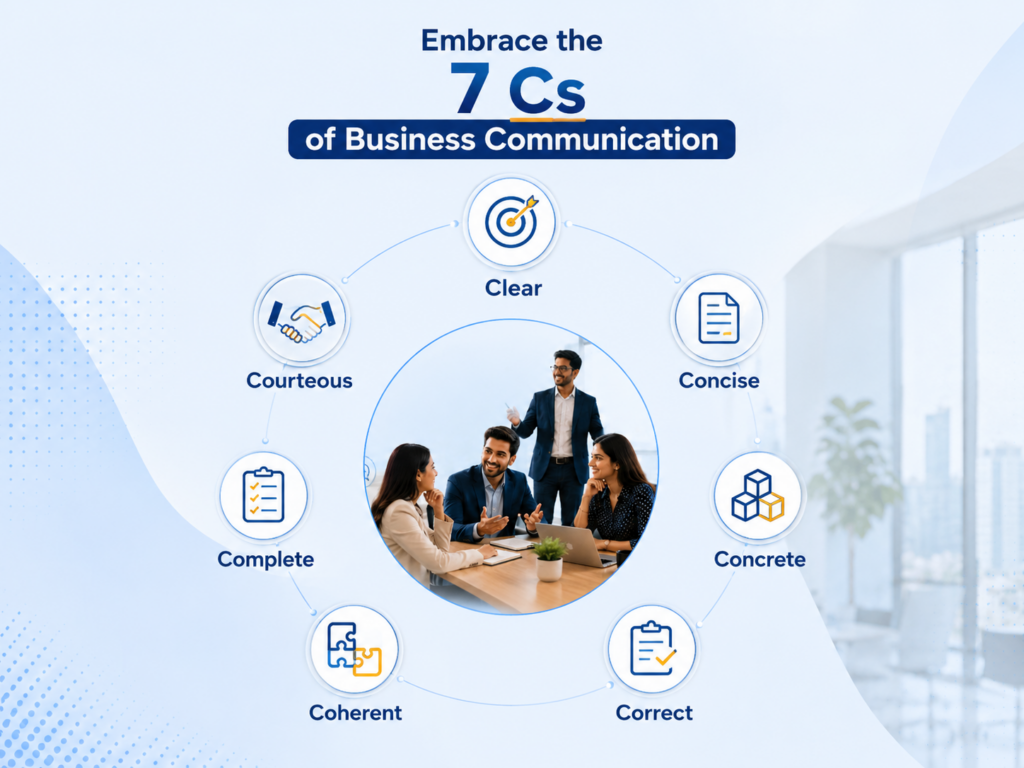
Whether you are writing an email, drafting a report, or giving a speech, ensure your communication checks these seven boxes:
- Clear: Be specific about your goal.
- Concise: Keep it to the point.
- Concrete: Provide facts and data.
- Correct: Check for grammar and factual errors.
- Coherent: Ensure a logical flow of ideas.
- Complete: Include a clear call to action (CTA).
- Courteous: Maintain a professional and polite tone.
Navigating the Challenges of Workplace English Training
For many Indian professionals, English is a second or third language. This can sometimes lead to an inferiority complex when communicating with native speakers or senior management. It is vital to remember that in business, clarity trumps vocabulary.
You do not need to use big, complicated words to sound intelligent. In fact, the most effective communicators use simple, direct language. Programs focused on workplace english training aim to strip away the complex jargon and focus on clarity. If you are ever in doubt, choose the simpler word. Use “use” instead of “utilize,” or “start” instead of “commence.” Clear, simple English is the universal language of global business.
Building Confidence: The Ultimate ROI
The most significant takeaway from completing a structured program—whether it is an intensive curriculum from Aksent, a specialized module from Coursera, or a high-end certificate from an IIM—is the profound boost in your self-confidence.
When you know exactly how to structure a presentation, how to diffuse a tense email thread, or how to advocate for your team in a boardroom, anxiety is replaced by assurance. This confidence is palpable. It is noticed by your peers, appreciated by your clients, and rewarded by your management.
Conclusion
The modern workplace is dynamic, fast-paced, and highly collaborative. Technical skills may get your foot in the door, but it is your soft skills that will carry you up the corporate ladder. The Top 10 Business Communication Courses in India highlighted in this guide offer a diverse range of solutions tailored to different career stages, budgets, and specific professional needs.
From fresh graduates looking to make a strong first impression to seasoned executives aiming to refine their leadership presence, there is a program perfectly suited for you. By choosing the right course, applying actionable techniques like the BLUF method, and committing to continuous practice, you will transform the way you interact in the professional sphere.
Do not let a lack of communication skills be the bottleneck to your career growth. Invest in your ability to connect, persuade, and lead today, and watch as new doors of opportunity swing wide open for your professional future.