Understanding idiomatic expressions is key to mastering any language. These phrases often have meanings that aren’t obvious from the individual words.
They add color and depth to conversations, making them more engaging. Knowing these expressions can help you sound more like a native speaker.
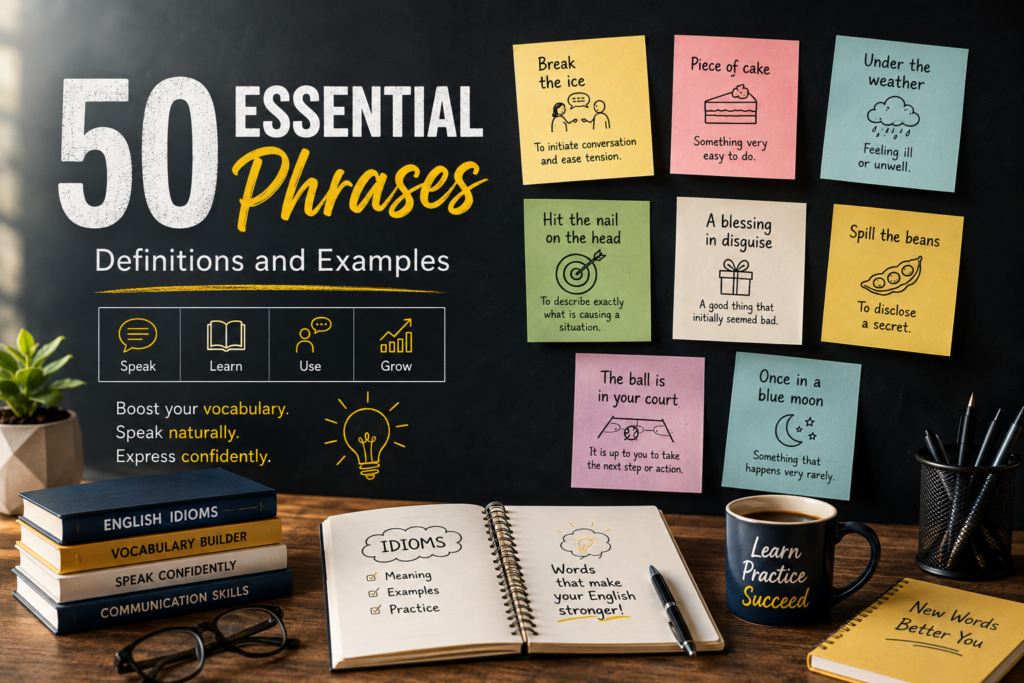
In this article, we explore 50 essential phrases with their meanings and example sentences. This list will enhance your vocabulary and improve your language skills.
Whether you’re a student, writer, or language enthusiast, these phrases are invaluable. They are commonly used in everyday conversations and writing.
Dive into this comprehensive guide and discover the richness of idiomatic expressions. You’ll find it both informative and enjoyable.
 by Buddha Elemental 3D
Why Learn Idiomatic Expressions?
Idiomatic expressions serve as a gateway to understanding the culture behind a language. These expressions reflect historical and cultural contexts, providing insights into how people think and communicate.
Learning idioms is essential for language fluency. They help you comprehend native speakers more easily. Without this understanding, conversations can be confusing, as idioms often aren’t literal.
Moreover, using idioms yourself can greatly enrich your communication. They allow you to express ideas more vividly and relate to others more effectively. This ability can lead to more engaging and dynamic interactions.
Consider these points when learning idioms:
- They enhance your conversational skills.
- They make writing more colorful.
- They reveal cultural nuances.
By mastering idiomatic expressions, you also strengthen your listening comprehension. Many idioms are used in movies, books, and everyday speech. Recognizing them will enable you to engage more fully with these media.

How to Use This List
This list is designed to be a practical tool for expanding your vocabulary. Whether you’re a student, a teacher, or just curious, you’ll find it helpful. Read through the phrases, understand their meanings, and then see how they are used in context with the example sentences provided.
Consider following this approach:
- Read each phrase and its meaning.
- Review the example sentence carefully.
- Practice using the phrase in your own sentences.
By doing so, you can effectively incorporate these idiomatic expressions into your everyday language use. This method will enhance both your speaking and writing skills over time.
50 Phrases with Their Meanings and Sentences
Break the ice: To initiate conversation in a social setting and ease tension.
Example: At the party, John told a joke to break the ice.
Bite the bullet: To face a difficult situation with courage.
Example: He had to bite the bullet and tell the truth.
Hit the nail on the head: To describe exactly what is causing a situation or problem.
Example: Her comment really hit the nail on the head about the issue.
Let the cat out of the bag: To reveal a secret unintentionally.
Example: She let the cat out of the bag about the surprise party.
Burn the midnight oil: To work late into the night.
Example: I had to burn the midnight oil to finish the report.
Kick the bucket: A euphemism for dying.
Example: The old man finally kicked the bucket after a long illness.
Under the weather: Feeling ill or unwell.
Example: I’m feeling a bit under the weather today, so I’ll stay home.
The ball is in your court: It is up to you to make the next decision or take action.
Example: I’ve done my part, now the ball is in your court.
Spill the beans: To disclose a secret, often by accident.
Example: Don’t spill the beans about the birthday gift.
Caught between a rock and a hard place: Faced with two difficult choices.
Example: She was caught between a rock and a hard place about moving or staying.
A blessing in disguise: A good thing that initially seemed bad.
Example: Losing that job was a blessing in disguise as she found a better one.
Costs an arm and a leg: Very expensive.
Example: That designer handbag costs an arm and a leg.
The best of both worlds: A situation where you can enjoy the benefits of two different things.
Example: Working from home offers the best of both worlds: career and family time.
Barking up the wrong tree: Pursuing a mistaken or misguided course of action.
Example: If you think I took your pen, you’re barking up the wrong tree.
Beat around the bush: To avoid getting to the point.
Example: Stop beating around the bush and tell me the news!
Break a leg: A way to wish someone good luck.
Example: Before her performance, everyone told her to break a leg.
Hit the sack: To go to bed.
Example: I’m exhausted and ready to hit the sack.
Piece of cake: Something very easy to do.
Example: Solving this puzzle was a piece of cake for him.
Once in a blue moon: Something that happens very rarely.
Example: I only see my cousins once in a blue moon.
When pigs fly: Something that will never happen.
Example: He’ll apologize? Yeah, when pigs fly.
Raining cats and dogs: Raining very heavily.
Example: We can’t go out now; it’s raining cats and dogs.
Through thick and thin: In both good times and bad times.
Example: They’ve stayed friends through thick and thin.
A dime a dozen: Something very common and not special.
Example: In this town, coffee shops are a dime a dozen.
Add insult to injury: To make a bad situation even worse.
Example: He failed the test and then, to add insult to injury, lost his wallet.
Burn bridges: To destroy relationships or connections.
Example: Be careful not to burn bridges with your old job.
Call it a day: To stop working for the day.
Example: We’ve done enough work, let’s call it a day.
Cut corners: To do something in the easiest or cheapest way, often sacrificing quality.
Example: The builder cut corners, which led to unsafe conditions.
Devil’s advocate: To argue against something for the sake of argument.
Example: I’ll play devil’s advocate to explore all perspectives.
Every cloud has a silver lining: There is something good in every bad situation.
Example: Losing that deal was hard, but every cloud has a silver lining.
Get out of hand: To become uncontrolled or chaotic.
Example: The party got out of hand when more people showed up uninvited.
Hit the books: To study hard or intensely.
Example: With exams coming up, I need to hit the books now.
In the heat of the moment: Overwhelmed by what is happening.
Example: He said things in the heat of the moment that he later regretted.
Jump on the bandwagon: To join a popular activity or trend.
Example: She jumped on the bandwagon and started a YouTube channel.
Keep your chin up: To stay positive despite difficulties.
Example: Even when things are tough, keep your chin up.
Kill two birds with one stone: To accomplish two tasks with a single effort.
Example: By carpooling, we could save gas and enjoy each other’s company, killing two birds with one stone.
Let sleeping dogs lie: To avoid interfering in a situation that is currently causing no problems.
Example: It’s better to let sleeping dogs lie and not discuss past arguments.
Miss the boat: To miss an opportunity.
Example: He missed the boat by not applying for the job sooner.
On the ball: To be alert and aware of things.
Example: The new manager is really on the ball and has improved everything quickly.
Pull someone’s leg: To joke with someone.
Example: Are you serious, or are you just pulling my leg?
See eye to eye: To agree with someone.
Example: We see eye to eye on most political issues.
Sit on the fence: To remain neutral or indecisive in a situation.
Example: It’s time to make a choice, you can’t sit on the fence anymore.
Speak of the devil: The person you were talking about appears.
Example: Speak of the devil, here comes John now.
Take it with a grain of salt: To not take something too seriously.
Example: I heard the gossip, but I’m taking it with a grain of salt.
The last straw: The final problem in a series that makes a situation intolerable.
Example: His constant lateness was the last straw; we had to let him go.
Throw in the towel: To give up or accept defeat.
Example: After several unsuccessful attempts, he decided to throw in the towel.
Under the gun: To be under pressure to do something.
Example: She is under the gun to complete the project by Friday.
Up in the air: Something that is uncertain or undecided.
Example: Our vacation plans are still up in the air.
Your guess is as good as mine: Having no idea about something.
Example: When it comes to the final score, your guess is as good as mine.
Bite off more than you can chew: To take on more than you can handle.
Example: She’s bitten off more than she can chew with this project.
Let the chips fall where they may: To let the outcome be determined without interference.
Example: I’m going to tell them the truth and let the chips fall where they may.
Each phrase represents a vivid part of conversational English. Embrace them, use them, and let them enrich your language. Mastering these idiomatic expressions will make your interactions colorful and engaging.
Frequently Asked Questions about Idiomatic Expressions
What Are Idiomatic Expressions?
Idiomatic expressions are phrases that don’t translate literally. Their meanings usually differ from the words’ individual definitions. These phrases often add color and depth to language.
Why Are They Important?
Understanding idiomatic expressions is vital for fluent communication. They help you grasp nuances and emotions in conversations. Without them, language can seem flat and hard to interpret.
How Can I Learn Them?
To learn idiomatic expressions effectively, include these strategies:
- Practice regularly in speaking and writing.
- Engage with native speakers to hear how they use them naturally.
- Watch movies or read books to see them in context.
Incorporating idioms in your everyday communication increases your fluency and comprehension.
Tips for Mastering Idiomatic Expressions
Mastering idiomatic expressions can significantly enhance your language skills. Start by immersing yourself in English media like movies, books, and music. This exposure helps you understand the context and nuance of these phrases.
Practice is crucial. Use idioms in your conversations to become more comfortable with them. Keep a journal of expressions you encounter and their meanings.
Here’s a list of additional tips for mastering idiomatic expressions:
- Speak with native speakers to gain real-world practice.
- Join language exchange groups for interactive learning.
- Create flashcards for quick and frequent review.
By consistently applying these tips, you’ll integrate idiomatic expressions naturally into your speech.
Conclusion
Understanding and using idiomatic expressions can elevate your language proficiency. This collection of 50 essential phrases with meanings and examples provides a solid foundation.
Keep practicing and incorporating these idioms into daily conversation. Over time, your understanding and confidence will grow, allowing you to engage more naturally with English speakers.