
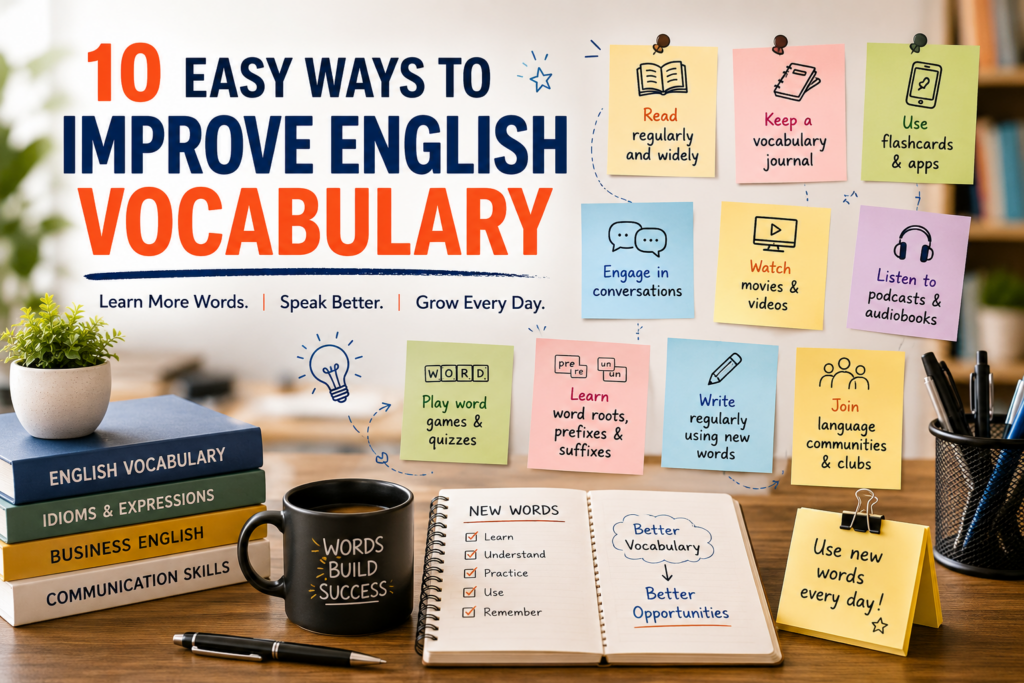
Improving your English vocabulary can open doors to new opportunities. It enhances communication skills and boosts confidence. Whether you’re a student, a professional, or just someone eager to learn, expanding your vocabulary is beneficial. Learning new words doesn’t have to be daunting. There are many easy ways to improve English vocabulary.
Reading is a powerful tool for vocabulary enhancement. It exposes you to new words in context. Keeping a vocabulary journal is another effective method. It helps track and remember new words.
Flashcards and vocabulary apps make learning interactive and fun. They aid in memorization and recall. Engaging in conversations with native speakers can significantly enhance English skills. It introduces you to everyday language use.
Watching English movies and TV shows is both entertaining and educational. Subtitles can aid comprehension and vocabulary growth. Listening to podcasts and audiobooks exposes you to diverse vocabulary. It also improves listening skills. Playing word games like Scrabble or crosswords makes learning enjoyable. It’s a fun way to learn new words.
Setting daily goals for learning new words can accelerate vocabulary growth. Consistency is key. Using new words in sentences reinforces their meanings. It helps in understanding how to use them correctly.
Joining English language clubs or online forums provides practice opportunities. It encourages active use of new vocabulary.

These strategies are practical and easy to implement. They can fit into any lifestyle.
Start your vocabulary journey today. With patience and persistence, you’ll see improvement.
1. Read Regularly and Widely
Reading is a fundamental step to enhancing English vocabulary. It introduces you to new words within context. This way, you understand not just the definition but also how they fit into sentences.
Diverse reading materials are essential. They provide a wide range of vocabulary. Fiction, non-fiction, newspapers, and even comic books each offer unique word sets.
Don’t stick to just one genre or style. Explore various types of reading materials such as:
Novels and short stories
Articles and essays
Magazines and journals
Each genre contains different vocabulary and language styles. This variety allows for broader vocabulary acquisition. Regular reading habits contribute to long-term improvement. Setting aside time each day for reading is crucial.
Keep a dictionary or an app handy. When you encounter an unfamiliar word, look it up immediately. This practice reinforces learning and understanding.
Engage actively with the text. Make notes, underline unfamiliar words, and jot down meanings. This active engagement helps with retention.
Join a book club or reading group. Discussing books introduces new perspectives and interpretations. It also introduces you to additional vocabulary through shared recommendations.
If you’re unsure where to start, create a reading list. Include books that interest you but also challenge your current vocabulary level.
Online libraries and e-books provide vast options. They often include built-in dictionaries to simplify learning. Here are some platforms you might find useful:
Project Gutenberg for free e-books
Kindle’s extensive collection for all genres
Online news platforms like BBC and The New York Times
Reading should not feel like a chore. Choose books and articles that spark your interest. When you’re engaged, learning becomes a natural and enjoyable process.

Remember, consistency is more important than quantity. Reading regularly, even if for short periods, promotes steady vocabulary expansion. Keep challenging yourself with new materials, and watch your vocabulary grow.
2. Keep a Vocabulary Journal
Keeping a vocabulary journal is a simple yet effective method. It helps track and review new words systematically. Writing things down aids memory retention and comprehension.
Start with a small notebook or digital app. Make it easily accessible for quick jotting. This will make it more likely you’ll use it consistently.
Each page should include new words along with their meanings. Also, note down example sentences. Seeing words used in context solidifies their meanings and uses.
Incorporate synonyms and antonyms of the new words. They provide a broader understanding and enhance language precision.
Here’s what your vocabulary entries might include:
Word: Definition, synonyms, antonyms
Example Sentence: A sentence using the new word
Word Origin: Knowing etymology can make words more memorable
Review your journal regularly. Repetition strengthens memory. Weekly reviews can reinforce what you have learned.
Categorizing words can also help. Grouping them by themes or topics, like “business” or “food,” makes searching easier.
Besides, you can personalize your journal. Add sections for idioms, phrasal verbs, or technical vocabulary relevant to your field.
Digital options like Evernote or OneNote offer convenient features. They allow tagging, which simplifies organization and search.
Here’s how digital tools can enhance your journal:
Easy search function for quick review
Multimedia support for added context (e.g., images or audio clips)
Backup and sync features for access across devices

Develop a habit of using the journal daily. Making it part of your routine ensures steady progress.
Utilizing a vocabulary journal is more than just writing down words. It’s an active learning practice that engages multiple senses. This promotes better understanding and long-term vocabulary development.
3. Use Flashcards and Vocabulary Apps
Flashcards are a tried-and-true method for vocabulary building. They offer quick, repeated exposure to new words. This boosts memory and recall abilities.
Physical flashcards are inexpensive and portable. You can carry them and review anytime, anywhere. Consistent review helps cement knowledge.
Digital flashcards offer additional benefits. Apps like Anki or Quizlet automate scheduling of word reviews. Spaced repetition ensures optimal memory retention.
Creating flashcards is simple. On one side, write the new word. On the reverse, add the definition and a sample sentence. This two-sided approach aids learning.
Here’s how to maximize flashcard effectiveness:
Limit each card to one word or phrase.
Include visuals if possible, like images or drawings.
Regularly shuffle to prevent memorization by order.
Online vocabulary apps provide similar functionalities. They often include gamified elements to make learning fun. Features like quizzes and achievement badges can maintain motivation.
Popular vocabulary apps and their features include:
Memrise: Uses engaging clips of native speakers for context
Duolingo: Offers a game-like interface with interactive quizzes
Babbel: Focuses on real-life conversations and scenarios

Track progress over time to see growth. Some apps offer analytics to show improvement areas. This can guide focused study.
Many apps also offer community features. Joining groups or challenges can provide external motivation. Users can engage in discussions and share tips with fellow learners.
Using flashcards and apps require commitment. Set aside a few minutes daily for reviews. Short, regular sessions are more effective than infrequent, long ones.
These tools are only valuable if used effectively. Balanced use can lead to significant improvements in vocabulary and overall English skills.
4. Engage in Conversations
Engaging in real-life conversations is a powerful way to enhance your English skills. Speaking and listening in real-time forces your brain to process language quickly. This practice helps reinforce vocabulary and introduces new words naturally.
Conversations with native speakers are especially beneficial. They expose you to correct pronunciation, slang, and idioms. If native speakers aren’t accessible, try language exchange programs. These provide a platform to practice with other learners or fluent speakers.
Don’t shy away from making mistakes. Errors are a natural part of learning a new language. Each mistake is an opportunity to understand nuances better. Over time, you’ll become more confident and fluent.
To make the most of conversations, consider these tips:
Listen actively and note new words or expressions.
Ask questions to gain clarity on unfamiliar terms.
Paraphrase to confirm your understanding.
Joining clubs or meetups focused on English conversation can also be beneficial. Participating in discussions exposes you to diverse vocabulary and contexts. These social environments encourage spontaneous use of language, promoting quicker thinking.

Online platforms offer similar opportunities. Websites like Meetup or conversational language apps connect learners and speakers worldwide. This global interaction exposes you to varied accents and dialects, enhancing listening skills.
Role-playing is another engaging method. It’s fun and effective for practicing specific vocabulary sets. By simulating real-life scenarios, you prepare for actual situations, building both language and confidence.
Be patient with yourself. Fluency takes time and practice. It’s crucial to stay committed and regularly engage in conversations. Set goals for yourself—maybe converse with three new people each week.
Remember, every conversation is a valuable learning experience. Keep a journal of your learnings. Reflecting on your progress can highlight improvement areas and boost motivation.
By consistently engaging in conversations, your vocabulary and overall language proficiency will markedly improve. Whether through face-to-face interactions or online chats, the key is regular practice and persistence.
5. Watch English Movies, TV Shows, and Videos
Watching English movies, TV shows, and videos is an enjoyable method to improve your vocabulary. It combines entertainment with learning, making the process less daunting and more engaging. This technique exposes you to authentic language used in real-life situations.
Start by choosing content that interests you. This could be documentaries, comedies, dramas, or even educational videos. Your interest in the subject matter will drive your enthusiasm to learn.
Using subtitles can significantly enhance comprehension and retention. Start with English subtitles if you’re just beginning. This helps link spoken and written language, strengthening understanding.
As your skills improve, challenge yourself by watching without subtitles. This encourages active listening and helps you pick up nuances in pronunciation. You’ll start recognizing common phrases and slang used in everyday conversations.
Here are some tips to maximize vocabulary learning through movies and shows:
Pause and replay to catch difficult words.
Note down unfamiliar words and look them up later.
For beginners, animation films are a great starting point. They usually have clear diction and straightforward vocabulary. For more advanced learners, dramas and series with complex plots provide rich vocabulary and idiomatic expressions.

Try setting goals, like watching one English movie or a few episodes per week. This consistency helps reinforce learning. Discussing the content with friends or in online groups can further solidify your grasp of new words.
Platforms like Netflix, YouTube, and other streaming services offer a vast library of English content. This variety ensures you are constantly exposed to new vocabulary and contexts.
If you encounter a challenging video, don’t get discouraged. Consider it an opportunity to stretch your listening skills. Remember, the more you immerse yourself in English content, the more natural the language will feel.
By regularly engaging with movies and TV shows, you’re likely to see noticeable improvements in your English vocabulary and overall language skills. Enjoy the learning journey, knowing each viewing session contributes to your growth.
6. Listen to Podcasts and Audiobooks
Podcasts and audiobooks are excellent resources for expanding your English vocabulary. They offer flexibility, allowing you to learn on the go. Whether you’re commuting, exercising, or doing chores, you can listen and learn anywhere.
Select topics that spark your interest. Whether it’s mystery stories, history, or language lessons, there’s something for everyone. This makes the learning process enjoyable and personalized.
Podcasts come in various genres, catering to all interests. They often feature native speakers, exposing you to different accents and speaking styles. This enriches your listening skills and familiarizes you with diverse language uses.
Here are some strategies to maximize vocabulary growth:
Focus on context clues for understanding new words.
Revisit segments that are challenging or particularly insightful.
For audiobooks, start with simplified readers if you’re a beginner. As your comprehension improves, transition to more complex literature. This gradual increase in difficulty helps maintain motivation and engagement.

An effective practice is to maintain a vocabulary list. Jot down unfamiliar words or phrases you encounter during your sessions. Later, review them, look up their meanings, and try using them in sentences.
There are several platforms like Spotify, Audible, and Apple Podcasts that offer extensive selections. Take advantage of these platforms to find content that suits your level and interests. Some podcasts even provide transcripts, helping you follow along more easily.
To ensure consistency in learning, integrate listening into your daily routine. Even a short session each day can lead to significant improvements over time. Plus, repetition enhances memory retention, making new vocabulary stick.
Listening actively helps in understanding pronunciation, intonation, and context. Over time, you’ll notice an improvement in your vocabulary and overall understanding of English. Keep exploring new genres and authors, and watch your vocabulary expand.
7. Play Word Games and Quizzes
Playing word games and engaging in quizzes are fun ways to improve your English vocabulary. They entertain and stimulate your mind, making learning enjoyable. Many games test your knowledge and challenge your skills.
Games like Scrabble, Boggle, and Words With Friends are popular choices. They require you to think of words based on letters or themes, enhancing your word recall. These games encourage you to think critically and creatively.
Quizzes add another dimension to learning. They test your understanding and retention of words. Online platforms offer vocabulary quizzes at various difficulty levels, suitable for all learners.
Here are some benefits of word games and quizzes:
They enhance creativity by encouraging you to construct words.
They build competitive spirit, which can drive learning in a fun way.

Another effective tool is crossword puzzles. These puzzles prompt you to fill in the blanks based on clues given, improving comprehension and spelling. Solving crosswords regularly can considerably grow your vocabulary.
Playing word-search games also helps. They involve identifying specific words hidden in a jumble of letters. This enhances your attention to detail and pattern recognition, supporting vocabulary building.
Online platforms like Wordscapes and Anagram Genius provide virtual word challenges. These platforms offer convenience and variety, allowing you to practice anytime. Interactive apps on smartphones make it easy to play and learn daily.
To maximize your growth, diversify the types of games and quizzes you play. Try incorporating them into your routine, even if just for a few minutes daily. This consistency will gradually expand your vocabulary, making new words part of your language repertoire. So, let the games begin, and watch your English skills flourish!
8. Learn Word Roots, Prefixes, and Suffixes
Understanding word roots, prefixes, and suffixes can significantly enhance your English vocabulary. Learning these elements helps you decipher unfamiliar words and their meanings. They form the building blocks of language, offering invaluable insights.
Word roots form the core meaning of a word. For example, “bio” means life, seen in words like biology and biography. By learning common roots, you can guess the meaning of new words with ease.
Prefixes modify the meaning of words by adding a small beginning element. Take “un-” as an example, which often means not, changing honest to dishonest. Knowing just a few prefixes can help you understand many words.
Suffixes are added to the end of words, altering their function. For instance, adding “-ness” to happy makes it happiness, changing an adjective to a noun. Mastering suffixes boosts your ability to use words correctly in different contexts.
Here are ways to integrate roots, prefixes, and suffixes into your vocabulary learning:
Create flashcards listing common roots, prefixes, and suffixes.
Practice breaking down complex words into these components.

Regularly practicing with these components makes new words less intimidating. Start by identifying these elements in words you encounter daily. This habit builds confidence and allows smoother reading.
Online resources and apps can simplify this practice. They offer exercises and quizzes tailored to teaching word parts. Using these tools helps solidify your understanding and maintains learning momentum.
Remember, language is a dynamic and interconnected system. Roots, prefixes, and suffixes are essential to understanding this system. By embracing these elements, you unlock the potential to understand and use a broader range of vocabulary effectively. With time, your grasp of English grows deeper and more intuitive.
9. Write Regularly Using New Words
Writing is a powerful tool for solidifying your vocabulary knowledge. When you write, you actively engage with words, reinforcing their meanings and usages. This practice helps new words become part of your active vocabulary.
Start by setting small writing goals. You might aim to write a short journal entry each day using words you’ve recently learned. These entries can be as simple as describing your day or writing down your thoughts.
Consider keeping a personal blog to document your vocabulary journey. Writing blog posts allows you to explore topics of interest while incorporating new vocabulary. This dual benefit makes the learning process enjoyable.
Another effective method is to write creative stories or poems. This approach encourages you to think about word choice carefully. Creative writing invites exploration of different contexts and meanings for new words.
Here’s a list of writing activities to consider:
Journaling daily, focusing on themes that interest you.
Composing short stories based on random prompts that include new vocabulary.

Ensure to revise and edit your writing. This not only helps improve your language skills but also allows you to refine your understanding of how words fit together. Editing teaches you to express yourself more clearly and accurately.
Joining writing communities, online or locally, can provide motivation and constructive feedback. Peer reviews highlight areas of improvement and suggest alternative vocabulary options. Engaging with others keeps your writing dynamic and exciting.
Language exchange partners can also offer writing practice opportunities. By communicating through writing, you practice articulating thoughts using new vocabulary. This method combines learning with cultural exchange, offering diverse perspectives.
Creating a vocabulary goal list aids in keeping track of your progress. Break it down into achievable targets, like writing a new word in three sentences. This specific focus encourages deliberate practice.
Remember, writing is both a learning tool and a reflection of your vocabulary growth. As you write regularly, you’ll notice a marked improvement in your ability to choose words confidently and express ideas effectively. With dedication, writing bridges the gap between passive recognition and active use of a rich vocabulary.
10. Join English Language Communities and Clubs
Engaging with English language communities and clubs is an excellent way to enhance your vocabulary. These platforms provide environments where you can practice with other learners and native speakers. They are invaluable for gaining real-world language experience.
Participating in discussions within these communities exposes you to various dialects and expressions. Hearing different speakers helps you grasp nuances in pronunciation and usage. It also allows you to pick up idiomatic language that textbooks may not cover.
Many local communities offer English language clubs, which often hold regular meetups. These gatherings focus on different language aspects, including vocabulary development. Attending them can boost your confidence in using new words.
Online forums and social media groups dedicated to English learning are also beneficial. They offer flexibility in participation and enable interaction with a global audience. This diversity enriches your learning experience, exposing you to varied language styles.
Here are some community-based activities to consider:
Online discussion boards where you can ask and answer questions.
Language meetups focusing on casual conversation and vocabulary challenges.
Joining book clubs that read and discuss English literature can also be impactful. They push you to delve deeper into word meanings and context. Analyzing literature with others sharpens your critical thinking and expression.
Engaging in these communities keeps you motivated. The social aspect makes learning enjoyable and less like a chore. You build connections with people who share similar goals, fostering an encouraging environment.
By joining such groups, you make learning an interactive and immersive experience. These communities provide continuous feedback and support, essential for long-term vocabulary growth. Being part of a community empowers you to use English confidently and fluently in various settings.
Bonus Tips for Lasting Vocabulary Growth
Achieving a robust vocabulary requires consistent effort and creative strategies. While regular methods work well, some additional tips can reinforce your learning process. Here are a few unique approaches to consider.
Incorporate vocabulary into daily routines. For instance, label household items with sticky notes that have their names in English. This visual interaction aids in quick recall and retention of new words.
Consider setting up reminders on your smartphone for a “word of the day.” Challenge yourself to use this word in conversations or writing throughout the day. Repetition in different contexts strengthens memory and understanding.
Explore the etymology of words you learn. Understanding a word’s history and its evolution can make it more memorable and meaningful. It often sheds light on related words, broadening your vocabulary further.
Here’s a quick checklist for actionable steps:
Set vocabulary goals weekly.
Read diverse genres of materials.
Practice active recall through quizzes.
Use words in context to ensure understanding.
Lastly, practice patience and consistency. Improvement might seem slow initially, but steady progress guarantees success. Embrace the journey and enjoy every new word you learn.
Common Mistakes to Avoid When Building Vocabulary
Learning new words is exciting, but some pitfalls can impede progress. It’s vital to be aware of these common mistakes to ensure effective vocabulary building.
One frequent error is focusing only on obscure or advanced words while ignoring common ones. Mastering daily vocabulary is essential for fluency and understanding.
Another mistake is rote memorization without context. Memorizing lists of words is less effective than learning them within sentences or scenarios.
Here’s a list of common vocabulary learning mistakes to avoid:
Neglecting common words.
Relying only on memorization.
Failing to use new words actively.
A balanced approach leads to better retention. Make use of new vocabulary in your conversations and writing tasks regularly, ensuring they become a part of your language toolkit.
Frequently Asked Questions (FAQs)
Many learners have questions about how to effectively enhance their English vocabulary. Here are some common queries and brief responses to guide your vocabulary journey.
How long will it take to see improvement? This varies for each person. Regular practice often shows results within a few weeks.
What’s the best method to learn new words? There isn’t one-size-fits-all. Experiment with different techniques to find what works best for you.
Here’s a quick FAQ list for further insights:
How often should I study? Daily practice is most effective.
Do language apps work? Yes, they offer structured learning.
Is speaking or writing better? Both are important for well-rounded skills.
Remember, patience and persistence are keys to seeing progress. Mix these methods for an engaging learning process.
Conclusion: Start Your Vocabulary Journey Today
Improving your English vocabulary opens doors to better communication and understanding. It enhances your confidence and enriches your interactions with others. As you embark on this journey, remember that consistency and dedication are your best allies.
Take the first step by choosing a method you enjoy. This could be reading a book, watching a movie, or keeping a vocabulary journal. Small, daily efforts add up to significant improvements over time. Don’t rush the process; savor each new word learned and used correctly.
Keep track of your progress and set achievable goals. This will help keep you motivated and focused. Here’s a quick checklist to get you started on your vocabulary journey:
Choose one new word each day.
Use language learning apps.
Engage in conversations regularly.
Dive into diverse reading materials.

Your journey is unique to you, and it will be as rewarding as you make it. Start today, be patient, and watch your language skills flourish with each step. Let curiosity and enthusiasm guide you to new linguistic heights.